Checked Blazers
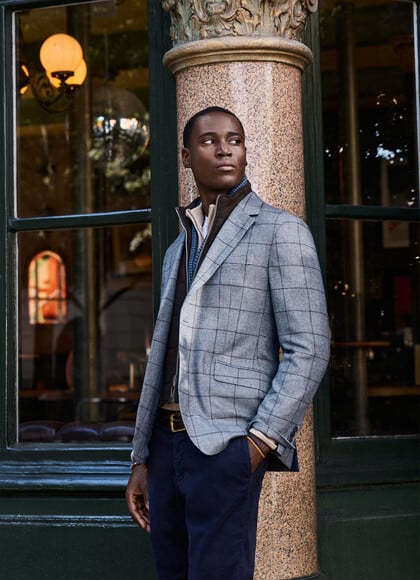
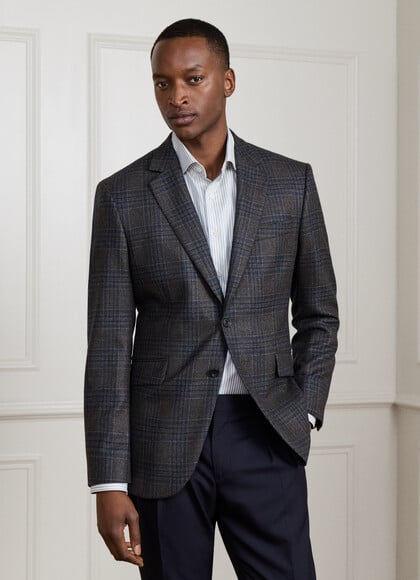
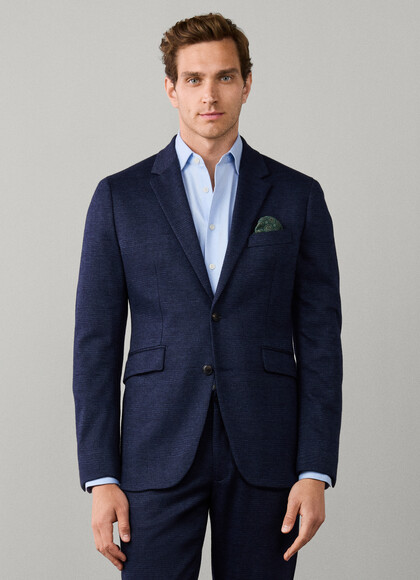
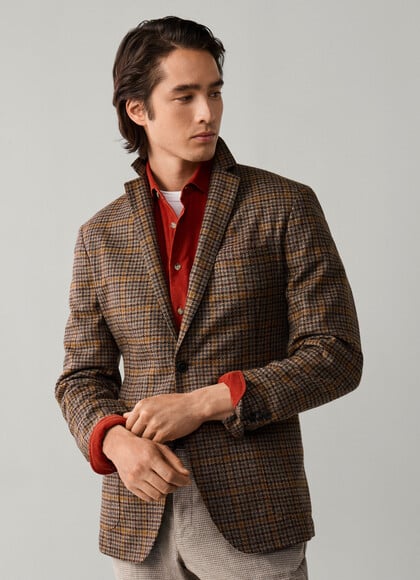
Men's checked blazer
The men's checked blazer from Hackett London draws on some of the most historically rooted patterns in British tailoring — from Prince of Wales to Glenurquhart, from gun club to windowpane — rendered in constructions built for the contemporary wardrobe.
Check patterns in British tailoring
The men's checked blazer is among the most immediately recognisable expressions of British menswear, and Hackett London — present continuously in the category since the mid-1980s — is a considered custodian of that tradition. The patterns in the collection each carry specific origins. The Prince of Wales check — an oversized grid with a fine overcheck in a contrasting colour — has historical associations with the British royal family and the ease of country house dressing. The Glenurquhart, or Glen check, is the most structured of the group: alternating bands of different widths that produce a three-dimensional surface effect. The gun club check combines two or three colours in a tighter grid, more discreet and better suited to formal contexts. In every case, the Hackett London men's checked blazer uses patterns woven into the cloth rather than printed onto it — meaning the motif has the same definition on both faces of the fabric and will not fade over time.
Fabrics across the range run from tightly woven combed worsted at 280–350 g/m² to virgin wool tweed with a more open, textured surface. Both approaches preserve the pattern integrity while delivering different surface qualities and seasonal weights.
How to wear a checked blazer
The guiding principle with a men's checked blazer is straightforward: one pattern at a time. The check carries enough visual information on its own; everything else in the look works best in plain cloth. Two concrete combinations:
Grey and white Prince of Wales blazer over a white shirt, dark grey flannel trousers and brown leather derbies: the combination that works in any meeting without looking like a uniform.
The same blazer over a light grey cashmere crew-neck, sand-coloured cotton chinos and suede loafers: the relaxed register, with the check doing all the work.
Warm-toned checks — browns, moss greens, burgundy — pair most naturally with trousers in cool neutrals: grey and beige absorb the energy of the pattern without suppressing it. Blue-dominant checks, being more formal in character, work best anchored by grey and white throughout the rest of the look.
Check scale and formality
There is a direct relationship between check scale and the appropriate register for a men's checked blazer. Smaller checks — the gun club at under 2 cm repeat — read as near-formal at a distance and reveal their pattern only up close; they work well across most professional environments. Medium checks — the Glen between 3 and 5 cm — sit squarely in business casual territory. Overscale checks — a Prince of Wales above 6 cm — belong to the weekend and creative working environments. The slim fit amplifies the visual presence of a check; the regular fit distributes it across a wider surface, making it read slightly quieter.
How to find your size
In the Hackett London men's checked blazer, pattern alignment at the seams is part of the construction standard: the check is matched at the side seams and pockets, a process that requires more cloth and more time. If between two sizes, choose the larger — the pattern alignment is correct for the labelled size and may not be recoverable on a size between two.
Is a checked blazer suitable for the office?
It depends on the scale of the check. A gun club in grey and blue on a light ground is compatible with most professional environments, including finance and law in many markets. An overscale Prince of Wales in strong tones is better placed in creative sectors or social occasions. The key is always the coherence of the whole look: plain trousers and a restrained shirt balance any check.
What shoes work with a checked blazer?
Plain leather in classic tones — brown, cognac, dark burgundy — works with most Hackett London checked blazers. Avoid heavily decorated or textured footwear: the blazer already carries enough surface interest on its own. A two-tone leather brogue in light-over-dark brown is perhaps the most internally coherent pairing with the British heritage aesthetic of the piece.
How do you care for a tweed checked blazer?
A tweed checked blazer from Hackett London requires dry cleaning as the primary care method. Between uses, a medium-bristle cloth brush applied in the direction of the weave removes surface dust and keeps the pattern definition clear. Never rub tweed; for marks, dab with a cold damp cloth and allow to air dry. A solid wide-shoulder hanger is essential: heavy tweed will deform on a narrow hook over time.