Suits
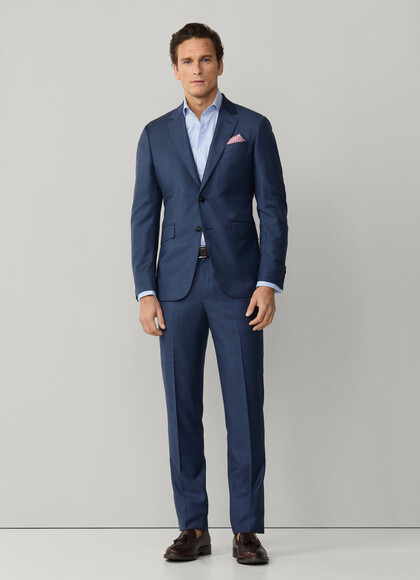
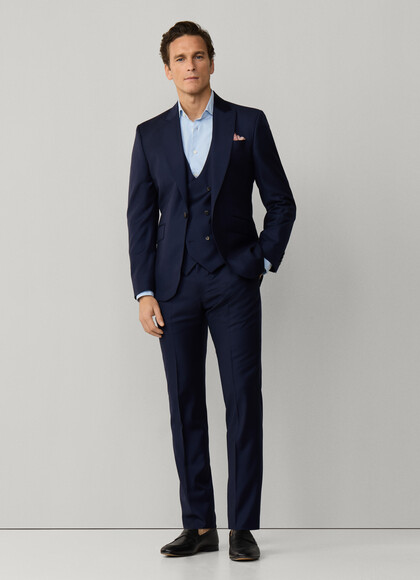

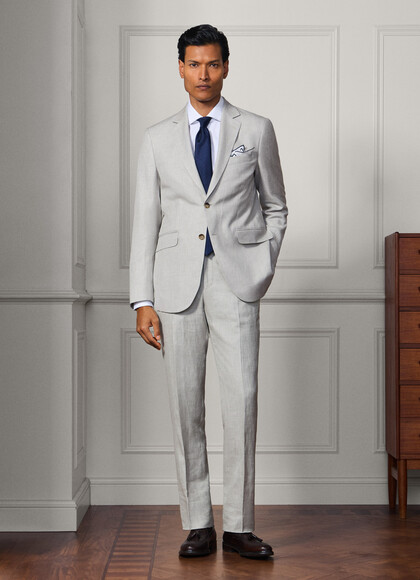
Men's suit waistcoats
Men's suit waistcoats from Hackett London are the most structurally revealing garment in the formal wardrobe: the piece that shows the level of construction most directly and extends a suit's usefulness well beyond what two pieces can achieve.
Construction and cloth
Men's suit waistcoats are cut from the same roll of cloth as their matching jacket and trousers — a non-negotiable condition, since two lengths of the same reference from different bolts will show tonal variation under natural light. The face is in superfine merino wool with a fibre diameter below 18 microns; the back is in silk mix or high-density viscose with a centre adjustment strap. Five or six horn or metal-alloy buttons close the front; buttonholes are hand-worked in the more carefully considered models. The convention of leaving the bottom button undone — a practice rooted in British tailoring tradition — preserves ease in movement and keeps the line clean when standing.
The waistcoat length is calculated so that the last visible button falls at the trouser waistband, with the shirt entirely covered. The shoulder seams sit just below those of the jacket so both layers stack cleanly. A waistcoat that is too short exposes the shirt when the wearer moves; one that is too long breaks the line of the trouser waistband.
How to wear men's suit waistcoats
The men's suit waistcoat adds a third register that a two-piece cannot reach. Two combinations:
Full three-piece — waistcoat, jacket and trousers from the same cloth — with a white shirt, a silk tie and leather Oxfords: the formal maximum for weddings, award ceremonies and any occasion where the full effort is expected and appreciated.
Waistcoat and matching trousers without the jacket, with a white Oxford shirt, open collar and leather shoes: a freestanding Smart Business outfit that uses the waistcoat as the structural anchor and needs no jacket to feel complete.
The divisibility of men's suit waistcoats is their clearest argument: three pieces from one cloth, several distinct combinations, a single considered purchase.
Fit and adjustment
The rear adjustment strap of a men's suit waistcoat allows a two- to three-centimetre range without requiring a tailor. Correctly adjusted, the waistcoat lies flat against the shirt through the torso without pulling at the buttons when seated. The fit check: seated, the waistcoat should stay flat across the chest; standing, it should cover the shirt completely without pulling at the hips.
Can a waistcoat be worn without the matching jacket?
Yes, and it is one of the most effective ways to use a three-piece suit across multiple contexts. Waistcoat and matching trousers with a shirt and shoes make a coherent and complete outfit in any setting that accepts Smart Business or Smart Casual. The condition is that the waistcoat sits correctly and the shirt is in good order — without the jacket, both are fully in view. The combination works especially well on days that move between formal and informal settings.
What is the difference between a matching and a contrast waistcoat?
A matching waistcoat is cut from the same cloth as the suit — identical in colour, texture and pattern. A contrast waistcoat is a separate piece in a different cloth or colour, used deliberately as a counterpoint to the rest of the outfit. Both approaches are correct. The matching waistcoat is the formal standard; the contrast waistcoat is the tool of a wardrobe assembled with accumulated knowledge and a clear point of view.
Should the bottom button of a waistcoat be left undone?
By tailoring convention, yes. Leaving the bottom button open is not a mistake — it is the rule, rooted in the same principle that keeps the bottom button of a single-breasted jacket undone. Fastening all buttons creates visible tension across the hips and pulls the waistcoat out of line. The convention applies equally to the jacket: both the waistcoat and the jacket read better — and sit better — with the bottom button left open.
How do you care for a wool suit waistcoat?
Dry clean alongside the rest of the suit so that all three pieces age at the same rate in terms of colour and texture. Between cleans, hang on a proper hanger rather than folding. Horn buttons are heat-sensitive; keep the iron clear of them. Loosen the rear adjustment strap after each wear so the back cloth can return to its natural shape before the next use.