Coats & Jackets
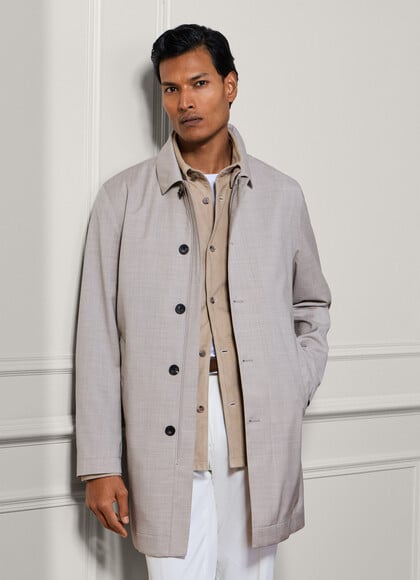
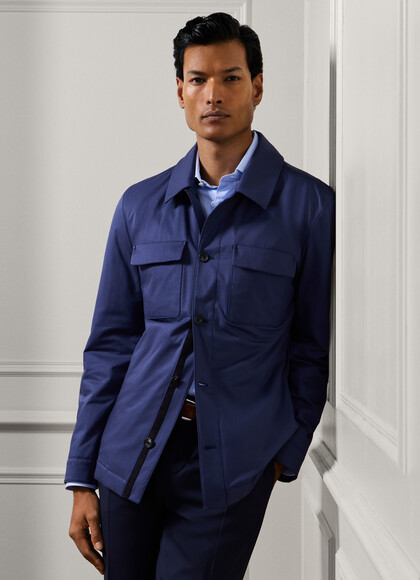
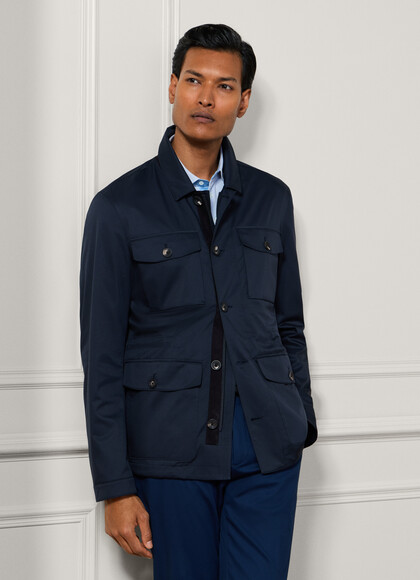
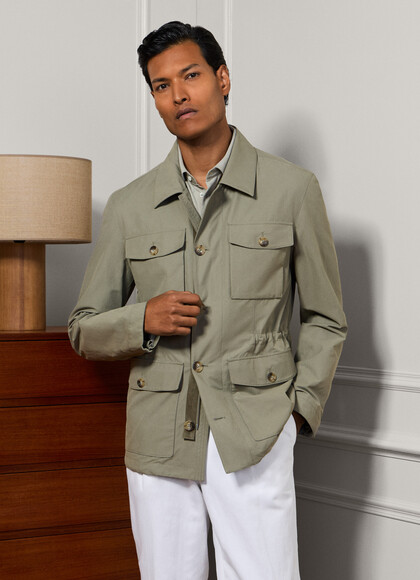
Savile Row coats and jackets
Savile Row coats and jackets from Hackett London apply the same construction logic to the outer layer as to the rest of the line: cloths that improve with every season, interior finishing at the same level as the exterior, and a cut calculated precisely for what goes underneath.
Materials and construction
Savile Row coats and jackets work principally with virgin wool cloth — 100% wool in the heavier models, wool-cashmere blends in the premium line — in weights ranging from 500 g/m² in the classic overcoat to 380 g/m² in transitional-weather models. The double-faced cloth, in which two layers of fabric are bonded without a visible lining, is the most refined option in the collection: edges are hand-finished, the garment requires no full lining, and the interior and exterior are finished to the same standard. Lined models use silk mix or high-density viscose that slides over a blazer without friction or static.
The floating canvas in the chest of the jackets — applied with the same criterion as in the suit jackets — allows the cloth to move with the body without losing its structure. Shoulder padding in current references is minimal or absent: the shoulder follows the natural anatomy of the wearer.
Models and silhouettes
Savile Row coats and jackets include the double-breasted overcoat, the straight coat with bellows pockets, the field coat in waxed cotton, the double-knit blazer and the wool technical overshirt. The dominant silhouette in the overcoats is straight with a natural shoulder; in the jackets, semi-fitted to allow layering underneath without losing the fall.
How to wear Savile Row coats and jackets
The outer layer defines the reading of the whole composition. Two combinations:
Navy wool overcoat over a grey suit, white shirt and black leather Oxford: the look with the greatest authority in the line, correct from a formal business meeting to an evening social engagement.
Waxed cotton field coat in khaki over a heavy-knit grey jumper, dark denim and Chelsea boot: the register drops to urban outdoor — the waxed cloth holds its position without explanation.
Savile Row coats and jackets are cut with calculated ease to accommodate a blazer or a jumper underneath: the coat shoulder must sit exactly on the shoulder of the suit jacket, not beyond it. Worth checking at the fitting stage with the layer most regularly worn below.
Care
Savile Row coats and jackets in wool are dry clean only. Between cleans, air on a wide-shouldered hanger for at least an hour — wool recovers its shape and releases moisture without intervention. Brush with a natural-bristle cloth brush after each wear. Waxed cotton models clean with a cool damp cloth — never dry cleaning, never the washing machine.
What is the difference between an overcoat and a straight coat in the Savile Row line?
The overcoat is double-breasted with more sweep at the hem and more cloth overall: it is the most formal option and the one that best accommodates a structured blazer underneath. The straight coat is single-breasted with a cleaner silhouette and less volume; it works equally over a blazer or a jumper, with a slightly less formal register. Both share the same cloths and the same construction standard within the Savile Row line.
Can a Savile Row jacket replace a blazer?
Depending on the model. A double-knit blazer or a wool technical overshirt from the line functions well in Smart Casual as a direct alternative to a blazer: it brings structure and volume without the rigidity of a canvassed jacket. In contexts that require a blazer with lapels — formal meetings, weddings, presentations — it does not replace it; but across most working days, it holds that role comfortably.
What weight overcoat from the Savile Row line is most versatile?
Between 380 and 420 g/m² in virgin wool. Substantial enough for autumn and winter wear, without being excessive in heated interiors or transitional months. Above 500 g/m² the coat is warm but heavy for daily use; below 350 g/m² it may fall short on a genuinely cold day. For a single coat from the line, the middle weight is the most rational investment.