Cashmere
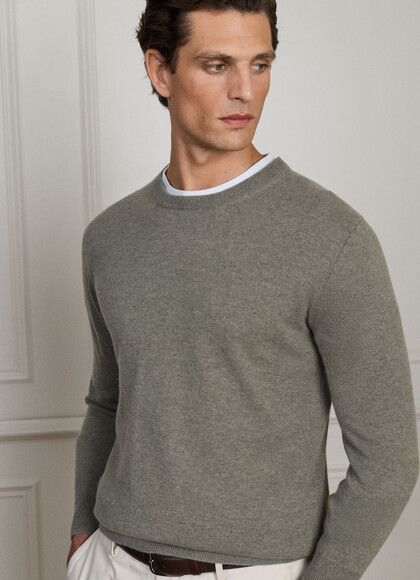

Men's cashmere jumpers
Men's cashmere jumpers sit at the top of the Hackett London knitwear range, built from a fibre that earns its price through warmth-to-weight rather than appearance alone.
What makes cashmere different from wool
A men's cashmere jumper is spun from the fine undercoat fibre of cashmere goats, harvested by combing rather than shearing, which is why the yield per animal is so much smaller than sheep's wool and the price reflects that scarcity. The range works with 2-ply cashmere at a fine gauge, twisting two strands together for added strength without sacrificing softness — a single-ply cashmere feels softer initially but pills and thins considerably faster under regular wear. Fibre diameter sits well under 19 microns in the better grades, finer than even premium merino, which is why cashmere feels soft against the skin without any need for an undershirt.
A fully fashioned construction, knitting each panel to its finished shape rather than cutting from a larger piece, avoids the raw seams that would otherwise waste this costlier yarn.
Weight and warmth without bulk
A cashmere jumper at a fine gauge delivers warmth that a much heavier lambswool jumper would need double the weight to match, which is what makes cashmere the natural choice for layering under a coat without adding visible bulk.
A charcoal cashmere crew neck under a navy overcoat with grey flannel trousers, for a commute that stays warm without bulk under the coat.
The same jumper over an open-collar shirt with dark denim for an evening that doesn't need a jacket at all.
Caring for cashmere properly
A men's cashmere jumper should always be hand washed or dry cleaned, since the fine fibre is more prone to felting under machine agitation than coarser wool.
Why is cashmere more expensive than wool?
Cashmere comes from the limited undercoat of cashmere goats, combed by hand in small quantities each year, unlike sheep's wool which is sheared in much larger volumes annually. The finer fibre also requires more careful processing to avoid damage. This combination of scarcity and delicate handling is what drives the higher cost.
How can you tell if a cashmere jumper is good quality?
A 2-ply construction generally outlasts a single-ply cashmere, since the twisted yarn resists pilling and stretching better over time. Fibre length also matters — longer fibres produce a smoother, more durable knit than short, brittle ones. Checking the weight and density of the knit against the light is a reliable way to judge quality before buying.
How should a cashmere jumper be washed at home?
Hand washing in cool water with a wool-specific detergent, then laying the jumper flat to dry, is the safest approach for cashmere at home. Machine washing, even on a wool cycle, carries more risk of felting the fine fibre than washing wool. Avoiding wringing or twisting the wet jumper prevents distortion of its shape.