White T-Shirts
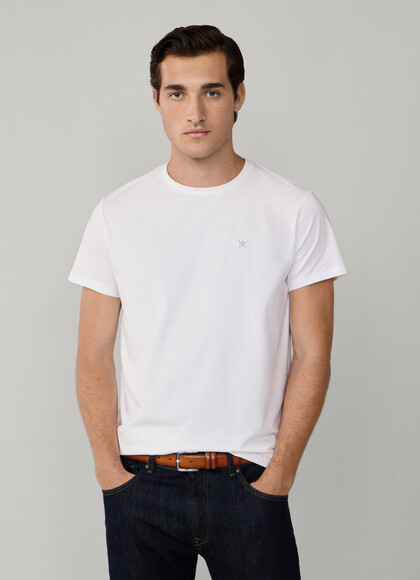




Men's white t-shirts
Men's white t-shirts are the hardest colour to get right and the one Hackett London has never diluted with a shortcut fabric — a plain white tee has nowhere to hide.
Why fabric quality matters more in white
A men's white t-shirt shows every flaw a coloured tee can disguise, from uneven knit to a thin, see-through weave, which is why the range sits at a denser 200-220 g/m² than the standard cotton tee. A tighter gauge knit, meaning more stitches per inch, is what stops white cotton going sheer under bright light. Optical whitening agents, applied during finishing rather than dyeing, are what keep white cotton looking bright rather than drifting towards cream after repeated washing.
A double-layered front panel, used on some of the heavier-weight styles, adds enough density at the chest to eliminate the see-through problem entirely without adding noticeable weight elsewhere in the garment.
Keeping white looking white
White cotton yellows fastest when exposed to body oils and antiperspirant residue left in the fabric after washing at too low a temperature. A white t-shirt washed at 40°C with a proper rinse cycle keeps its brightness noticeably longer than one washed cold to save the fabric — cold water simply doesn't clear residue as effectively.
A crisp white crew neck under a navy cotton blazer with grey trousers, for a look that reads deliberately simple rather than underdressed.
The same tee with white trainers and stone chinos for a weekend that leans entirely on fit rather than colour.
Avoiding the see-through problem
Holding a men's white t-shirt up to a window is the simplest test of quality before washing even begins — light passing through easily signals a thin, low-density weave. Denser fabric at 200 g/m² and above rarely has this problem, regardless of colour.
Why do white t-shirts turn yellow over time?
Yellowing comes from a build-up of body oils, deodorant residue and detergent film that isn't fully rinsed out during washing, particularly at lower temperatures. Sunlight exposure during drying accelerates the effect further by oxidising the residue left in the fibres. Washing at 40°C with a full rinse cycle and avoiding fabric softener slows the process considerably.
How can you stop a white t-shirt going see-through?
Choosing a denser fabric, ideally above 200 g/m², is the most reliable fix, since thin cotton is the root cause rather than the colour itself. Some styles include a double-layered front panel specifically to prevent this. Wearing a plain white undershirt beneath is an option, but a well-made white tee shouldn't need one.
Can white t-shirts be bleached to keep them fresh?
Occasional bleaching in a diluted solution can restore brightness, but frequent bleaching weakens cotton fibres and shortens the garment's lifespan considerably. Oxygen-based bleach is gentler on the fabric than chlorine bleach and achieves a similar brightening effect. Most white t-shirts are better maintained through correct washing temperature than through bleach at all.