Three Piece Suits
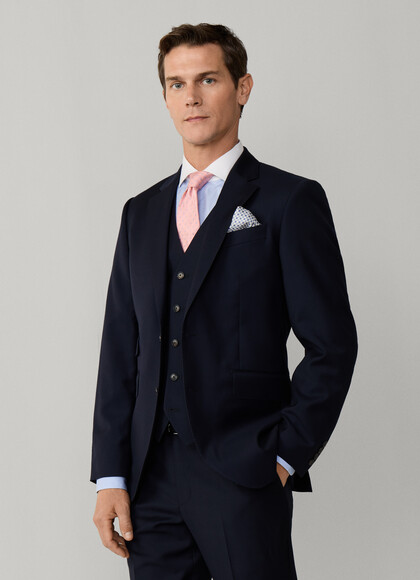
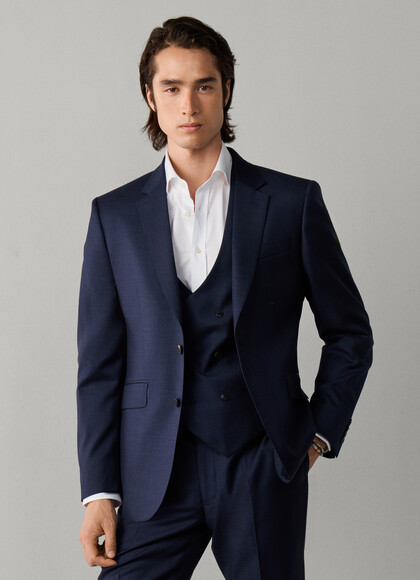
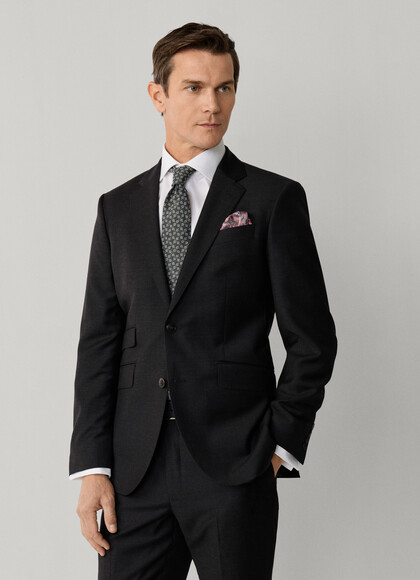
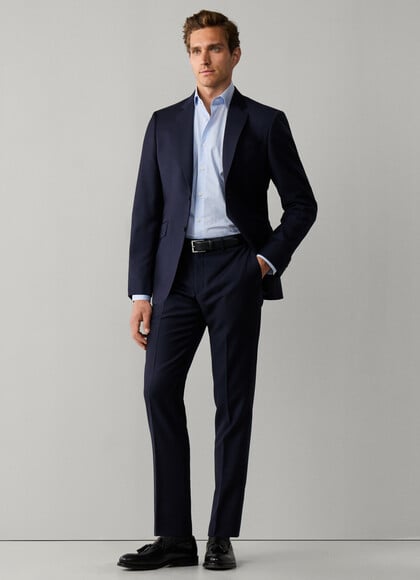
Men's three-piece suits
Men's three-piece suits from Hackett London are the fullest expression of British tailoring: jacket, trousers and waistcoat in the same cloth, a format built to carry the wearer through a full working week and a formal occasion without requiring a change in approach.
Construction and cloth
Men's three-piece suits require all three pieces to be cut from the same roll of cloth — a condition Hackett London observes without exception, since two lengths of the same reference from different bolts will show tonal variation under natural light. The cloth is 100% pure new wool in the main line, wool-cashmere blend in the premium models, at weights between 260 and 300 g/m² for year-round indoor wear. The jacket uses a floating canvas chest construction: the cloth moves with the body, the lapels develop a natural roll and the jacket holds its shape through years of wear and cleaning. The waistcoat face is in the matching suit cloth; the back is in silk mix or high-density viscose with a centre adjustment strap and five or six horn buttons at the front. The bottom button is left undone — a construction convention that preserves ease in movement and keeps the waistcoat's line clean when standing.
Hand pick-stitched lapels on the jacket and hand-worked buttonholes on the waistcoat — where the build warrants it — are the finishing details that signal quality at close inspection.
When to wear a three-piece suit
A men's three-piece suit sets a level of formality that a two-piece does not reach. Weddings, award ceremonies, formal dinners, business presentations at the highest level: occasions where presence is expected from the moment of arrival. The waistcoat also provides a practical transition: jacket removed, waistcoat retained, the formal register of the occasion is maintained while comfort is improved. This makes the three-piece particularly effective for events that run from ceremony through to reception and beyond.
How to wear men's three-piece suits
The three-piece opens three distinct registers. Two specific combinations:
Full three-piece in navy — waistcoat, jacket and trousers — with a white shirt, a silk tie and leather Oxfords: the complete formal combination for weddings, funerals and any occasion where the dress code is formal and the effort is expected to show.
Waistcoat and matching trousers without the jacket, with a white Oxford shirt, open collar and leather shoes: a complete Smart Business outfit that uses the waistcoat as the structural centrepiece and requires no jacket to read as finished.
The divisibility of men's three-piece suits is the argument that makes the investment rational: three pieces cut together, several distinct combinations from a single purchase, one cloth to unify them all.
Fit and proportion
The waistcoat of a men's three-piece suit should cover the shirt completely, with the last visible button falling at the trouser waistband. The shoulder seams sit just below those of the jacket so both layers stack cleanly. The fit through the torso should be close without pulling at the buttons when seated; the rear adjustment strap allows a two- to three-centimetre range of adjustment without requiring alterations.
What is the difference between a two-piece and a three-piece suit?
The waistcoat adds visual completeness and a level of formality that a two-piece does not provide, along with the practical ability to remove the jacket without losing the dressed quality of the overall look. A two-piece is more adaptable day-to-day and moves between dress codes more easily. For a deliberately built wardrobe, a three-piece in navy or mid-grey is a long-term investment that covers formal occasions across decades; a two-piece in the same cloth offers more daily flexibility.
Can the waistcoat be worn with other trousers?
Yes, with care. The matching waistcoat with matching trousers is always the clean and coherent read. Wearing the waistcoat with a contrasting trouser in a different cloth or colour works when the contrast is clearly deliberate — a tweed waistcoat over flannel trousers in a complementary tone, for instance. The risk is a combination that reads as accidental mismatching; when in doubt, the matching trouser is the correct answer.
What tie width works with a three-piece suit?
The tie width should echo the lapel width: 7 to 7.5 cm for the slim lapels of a Slim Fit, up to 8.5 cm for the wider lapels of a Regular Fit. The three-piece is already a fully stated look; the tie works best in a supporting role — a silk in a muted tone or a restrained pattern rather than a piece competing for attention independently.