Wool Suits
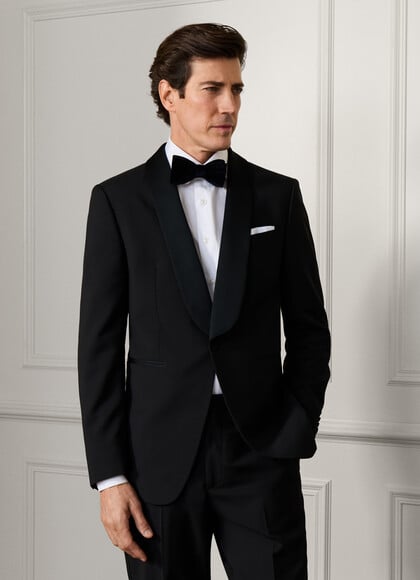
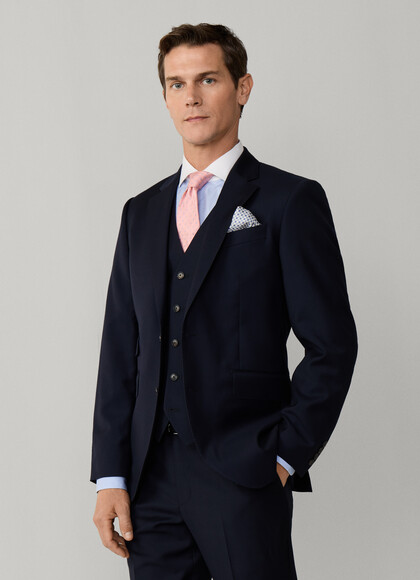
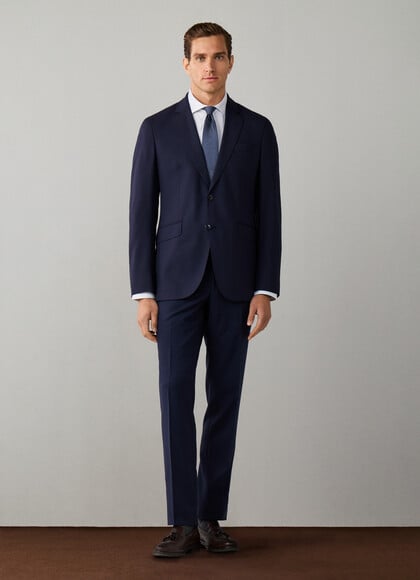
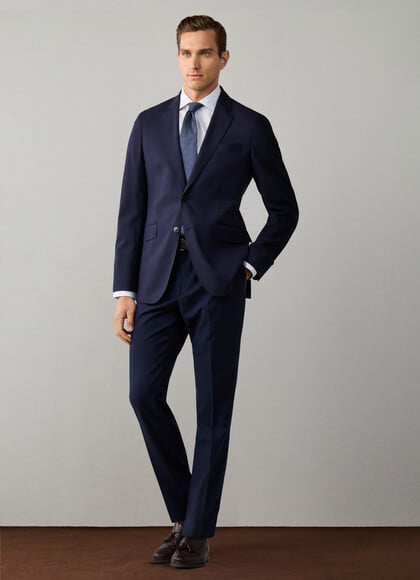
Men's wool suits
Men's wool suits from Hackett London are the foundation of a wardrobe built to last: natural thermoregulation, a construction that reveals its quality over time and a longevity that no synthetic alternative, however technically refined, can match.
Wool — the case for the natural fibre
Men's wool suits in 100% pure new wool form the core of the Hackett London tailoring collection. Fibre diameter determines the grade: below 18.5 microns for Superfine, below 16 microns for Ultra-Superfine in the premium line. Cloth weights cover the full year — tropical weave at 180–200 g/m² for spring and summer, mid-weight at 260–280 g/m² as the four-season standard, flannel and tweed from 300 g/m² upward for the cooler months. A mid-weight at 280 g/m² in navy or charcoal provides year-round versatility in temperate climates without any concession to comfort or structure.
The floating canvas — the chest construction in which the interlining is basted rather than fused to the cloth — is the detail that separates a suit built to improve with wear from one that deteriorates with it. The cloth moves with the body; the lapels develop a natural roll; the jacket holds its shape through cleaning and daily use. A floating canvas construction outlasts a fused jacket by a decade under normal wear: a fact that reframes the price of a well-made suit considerably.
Cut and silhouette
The men's wool suits collection runs from the Slim Fit with a marked waist and close leg through to the Regular Fit with a natural shoulder and a straight fall. Both are available in two- and three-piece configurations. Single-breasted with two or three buttons is the standard format; double-breasted with six buttons extends the range for occasions requiring greater presence. Notch lapels in the city line, peaked lapels in the ceremony models — hand pick-stitched in both.
How to wear men's wool suits
Wool is the most register-adaptable cloth in formal menswear. Two starting points:
Mid-grey flannel wool suit with a white poplin shirt, a silk tie in dark red and leather Oxfords: the combination that earns its place in a working wardrobe through sheer reliability — from a morning meeting to an evening dinner without a change.
The same suit without the tie, with a dark merino roll-neck underneath and leather Chelsea boots: the register drops clearly to Smart Casual without the suit giving up any of its authority.
The versatility of men's wool suits is a function of the fibre itself — wool absorbs light, structures the silhouette and reads as appropriate across a wider range of combinations and contexts than any other suit cloth.
Choosing the right wool suit
The first men's wool suit should be a mid-weight at 260–280 g/m² in navy or mid-grey: four-season versatile, suitable for the widest range of occasions and the safest foundation on which to build. A second suit adds a different cloth weight or colourway to extend the wardrobe's range. The construction — floating canvas or fused — is the technical criterion that most directly determines long-term value.
What makes a wool suit worth the investment?
Three things: fibre quality, construction and fit. Fibre quality determines softness, surface regularity and how the cloth holds its colour and shape over time. Construction separates a suit that improves with wear from one that degrades: a floating canvas is the standard that matters. Fit is non-negotiable — the best cloth and build in the world will look approximate in a jacket where the shoulder seam doesn't sit at the exact edge of the shoulder.
How often should a wool suit be dry cleaned?
Every four to six wears for the trousers; every eight to ten for the jacket, which has less direct contact with the body. Over-cleaning accelerates fibre breakdown — the solvents used in dry cleaning affect the handle of the cloth over time. Between cleans, air the suit on a wide hanger for at least an hour after each wear: wool is a self-cleaning fibre to a meaningful degree, releasing odours and moisture when given space and airflow.
Can a wool suit be machine washed?
No. A suit jacket with a canvas chest piece — floating or fused — cannot go in a washing machine. The outer cloth and the internal structure react differently to heat and water, producing permanent distortion in the chest and shoulder. For localised marks, a cool damp cloth pressed lightly against the area is the correct first response. For a full clean, dry cleaning is the only appropriate method.