Linen Blazers
Men's linen blazers
Men's linen blazers from Hackett London bring the kind of considered ease that earns its place across the warmer months — breathable construction, clean structure, and a weight that moves with you from a full working week into the weekend without complaint.
Construction and cloth: what makes a linen blazer work
Men's linen blazers live or die by the quality of the cloth and the honesty of the cut. Hackett London works with pure linen and linen-blend fabrics — typically 100% linen in the single-breasted wardrobe staples, and linen-cotton or linen-silk mixes in the more refined lines — woven to a mid-light weight that sits flat against the body without clinging. The natural slub of the yarn gives each jacket its own quiet texture: not uniform, not polished to excess, but the kind of surface that catches the light differently depending on how you move. Hombros naturales keep the shoulder clean and unconstructed, a deliberate departure from the padded formality of heavier tailoring, and one that suits the fabric's character precisely.
The half-lining — typically in breathable cotton or lightweight viscose across the back and sleeves — is the detail that separates a well-made linen blazer for men from one that merely looks the part. It keeps the jacket sliding cleanly over a shirt without the weight of a full silk lining, which would defeat the purpose of the cloth entirely. Pick-stitching on the lapel edge and a slightly soft chest — lightly structured canvas rather than rigid fused interlining — allow the jacket to drape naturally and recover its shape after a long afternoon.
Cuts and colours across the range
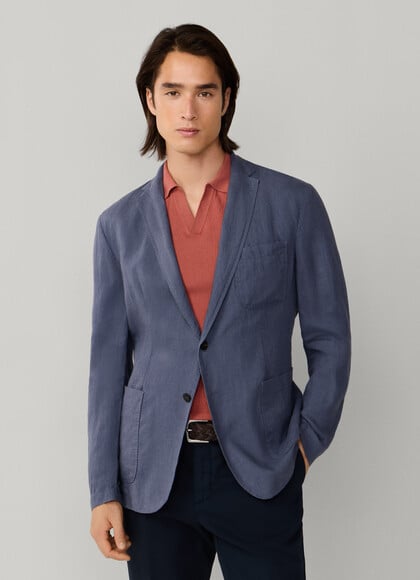
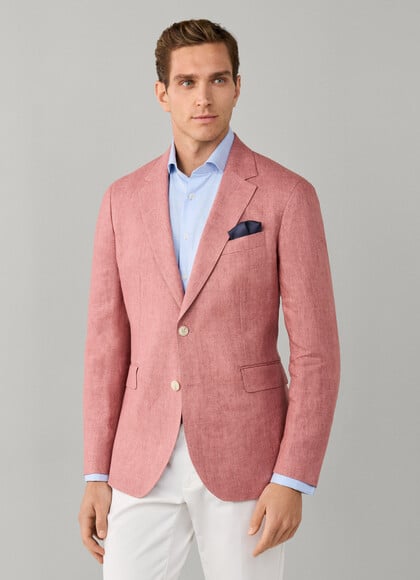
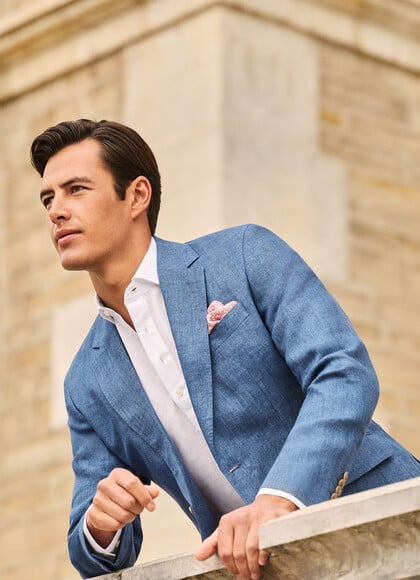
The men's linen blazers at Hackett London run from a close-fitting slim cut — defined chest, narrow sleeve, the lapel sitting flat without gap — to a more relaxed regular fit with a wider shoulder and room to layer. Natural ecru and warm off-white anchor the warm-weather end of the palette; mid-blue and indigo translate the linen's texture into something that reads as genuinely smart from a distance. Khaki and light olive sit in the middle ground, comfortable in the city and equally at home somewhere further afield. The slim-fit construction in the tighter cuts uses a slightly longer back length to preserve the jacket's line when worn open, which is, frankly, how most linen blazers spend most of their time.
How to wear a men's linen blazer
The range works without trying across a wider set of occasions than its relaxed character might suggest. Two directions worth considering:
A natural ecru linen blazer over a white linen shirt, worn open, with slim-fit chinos in stone and leather loafers — the right kind of quiet for a Chelsea lunch or a late afternoon at Ascot in the members' enclosure.
The same jacket over a fine-gauge merino crewneck in navy, with tailored trousers in mid-grey and suede Derby shoes — the temperature drops slightly, the register lifts, and the linen holds its own from an early-evening Pall Mall dinner through to whenever the evening decides to end.
Founded in 1983 in Chelsea, Hackett London has built its understanding of warm-weather tailoring around the particular demands of an English summer that can shift from twenty-two degrees to overcast in the same afternoon — and the men's linen blazer range reflects that: structured enough to read as a jacket, relaxed enough to carry the weight of a day that hasn't quite made its mind up.
How to choose the right size in Hackett linen blazers
Men's linen blazers from Hackett London follow standard European chest sizing, but linen behaves differently to wool. The cloth has less give than a stretch-blend and more movement than a stiff canvas — if you are between sizes, the smaller typically gives the cleaner line across the chest and shoulder. Bear in mind that pure linen relaxes and softens with wear, so a jacket that feels precise on day one will feel entirely natural by the end of the first week. The regular fit is the more forgiving choice for those who carry more volume through the chest or prefer to wear a shirt and light knitwear underneath. Sleeve length is set for a height between 178 and 182 cm; the half-lined construction makes alterations to sleeve length straightforward at any tailor worth visiting on Jermyn Street.
What is the difference between a pure linen and a linen-blend blazer for men?
A 100% linen blazer has more texture, breathes better in direct heat, and develops a distinctive soft drape over time; it will crease, which is part of its character and not a flaw. A linen-cotton or linen-silk blend introduces a smoother surface, reduces creasing noticeably, and holds its shape across a longer day with less attention — the trade-off is a slightly reduced breathability compared to pure linen. For occasions where you need the jacket to look composed from morning to evening without intervention, the blend is the practical choice; for weekends and less structured settings, pure linen rewards the latitude.
Do Hackett linen blazers crease, and how do you manage it?
Yes — and a linen blazer that does not crease at all is not made from linen. The cloth creases as a function of its structure, and the creases that form through wear are entirely different to the sharp folds of improper storage. Hanging the jacket on a wide wooden hanger overnight is enough for most creases to drop out naturally; a light steam from a distance of ten centimetres will resolve anything more persistent. Avoid direct contact from a hot iron on pure linen — it flattens the natural slub of the yarn and removes the texture that makes the cloth worth wearing in the first place.
Can a men's linen blazer be worn to a smart-casual office in summer?
A Hackett linen blazer in navy or mid-blue, worn over a fine Oxford shirt and slim-fit chinos, sits comfortably within most smart-casual dress codes and reads as deliberately considered rather than underdressed. The key is in the cut: a slim or regular fit with a clean shoulder and a structured-enough chest will carry the register of a jacket rather than a casual overshirt. The half-lined construction keeps the jacket looking composed even late in the day when temperatures have had time to make themselves known.


