Three Piece Suits
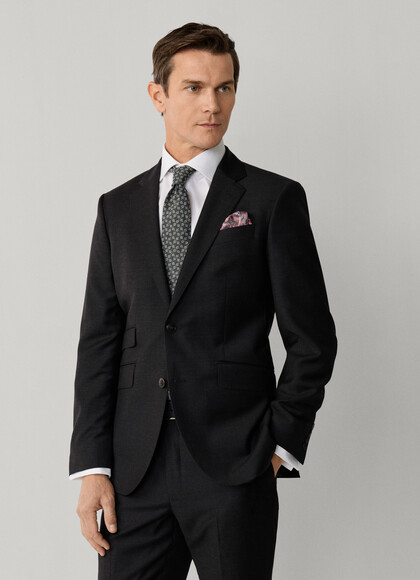
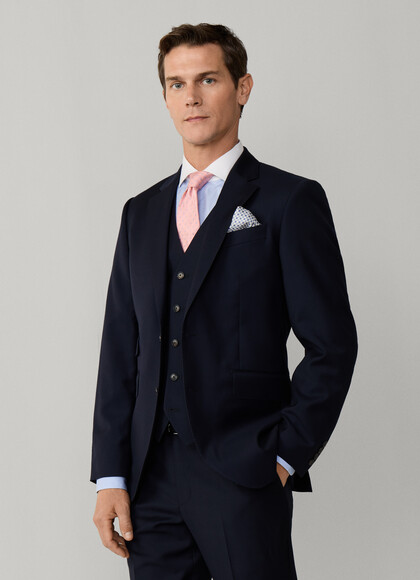
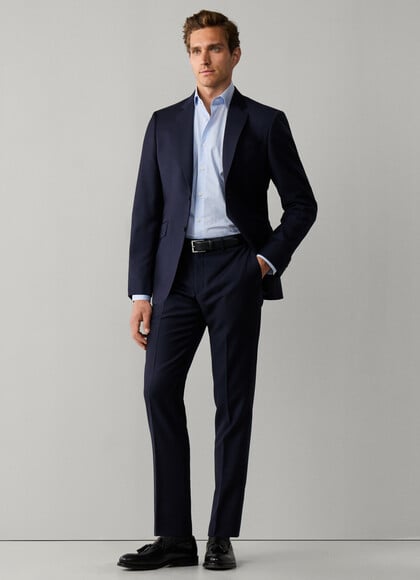
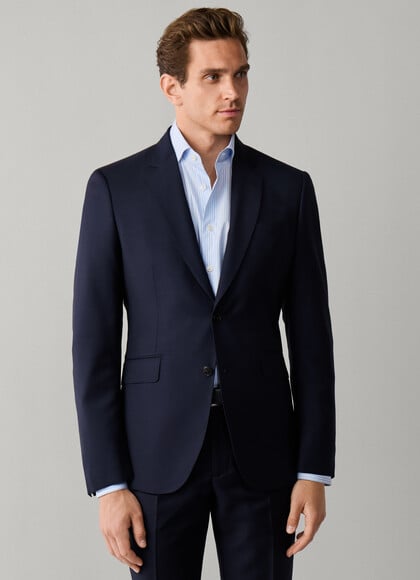
Men's three-piece suits
Men's three-piece suits from Hackett London are the most complete expression of British tailoring: jacket, trousers and waistcoat in the same cloth, a format that has earned its place in the formal wardrobe for well over a century and shows no sign of ceding it.
Construction and cloth
Men's three-piece suits require all three pieces to be cut from the same roll of cloth — a production constraint that Hackett London observes without exception, since two lengths of the same cloth reference from different bolts will show tonal variation under natural light. The cloth is 100% pure new wool in the main line, wool-cashmere blend in the premium models, at weights between 260 and 300 g/m² for year-round use in heated interiors. The jacket uses a floating canvas chest construction: the cloth moves with the body, the lapels develop their natural roll, and the jacket holds its shape through years of wear and cleaning. The waistcoat face is in the matching suit cloth; the back is in silk mix or viscose with a centre adjustment strap and five or six horn buttons at the front.
The hand pick-stitch on the jacket lapels — visible as a line of small stitches running parallel to the edge of the revers — is the detail that signals the level of the build at a distance. The buttonholes on the waistcoat, worked by hand in the more considered models, extend that signal to a closer inspection.
When to wear a three-piece suit
A men's three-piece suit sets a level of formality that a two-piece doesn't reach. Weddings, funerals, Ascot, prize-givings, board presentations, formal dinners: occasions where the full effort is not only appropriate but expected. The waistcoat also offers a practical advantage: jacket off, waistcoat on, and the formality of the occasion is maintained while the temperature is managed. This transition — from jacket-on ceremony to jacket-off reception — is one of the formats in which the three-piece genuinely outperforms the two-piece.
How to wear men's three-piece suits
The three-piece opens three distinct registers. Two specific combinations:
Full three-piece in navy with a white shirt, a silk tie and Oxfords in polished calf leather: the complete formal combination for weddings, funerals and any occasion where presence and respect for the dress code matter equally.
Waistcoat and matching trousers without the jacket, with a white Oxford shirt, open collar and tan suede derbies: an autonomous Smart Business outfit that uses the waistcoat as the structural anchor — no jacket required to make the look complete.
The divisibility of men's three-piece suits is the argument that makes the investment rational: three pieces cut from the same cloth, several combinations from a single purchase.
Fit and proportion
The waistcoat of a men's three-piece suit should cover the shirt entirely with the last visible button at the trouser waistband. The shoulder seams sit just below those of the jacket; the fit through the torso should be close without pulling at the buttons when seated. The bottom button stays undone — by British tailoring convention, always.
What's the difference between a two-piece and a three-piece suit?
The waistcoat adds a level of visual completeness and formality that a two-piece doesn't provide, along with the practical option to remove the jacket without losing the dressed quality of the look. A two-piece is more versatile day-to-day and adapts more easily across dress codes. For a wardrobe being built deliberately, a three-piece in navy or mid-grey covers formal occasions for decades; a two-piece in the same cloth offers more daily flexibility. Neither is the wrong choice — they answer different questions.
Can the waistcoat be worn with different trousers?
Yes, with some care. The matching waistcoat works well with the matching trousers — that's the clean, coherent read. Wearing the waistcoat with a contrasting trouser in a different cloth or colour works when the contrast is clearly intentional: a tweed waistcoat over flannel trousers in a complementary tone, for example. The risk is a combination that reads as accidental mismatching rather than considered contrast; when in doubt, the matching trouser is always the right answer.
What tie width works with a three-piece suit?
The tie width should echo the lapel width: 7 to 7.5 cm for slim lapels on a Slim Fit, up to 8.5 cm for the wider lapels of a Regular Fit. The three-piece is already a fully stated look; the tie works best in a supporting rather than competing role — a silk in a muted tone or a restrained pattern, not a piece that's trying to win the room independently.