Shirts
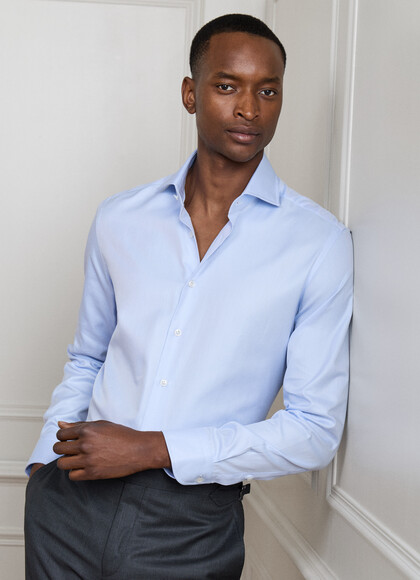
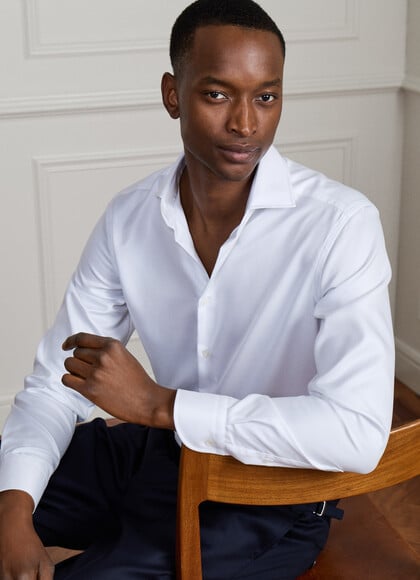

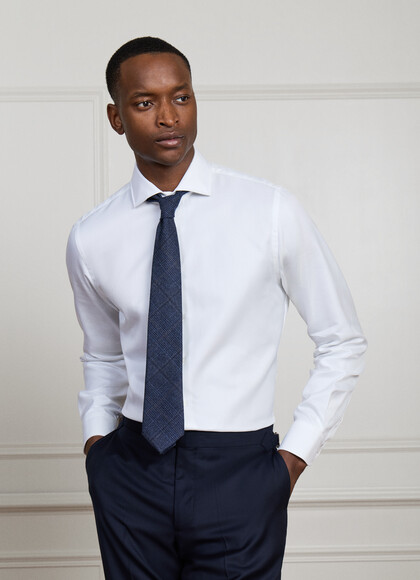
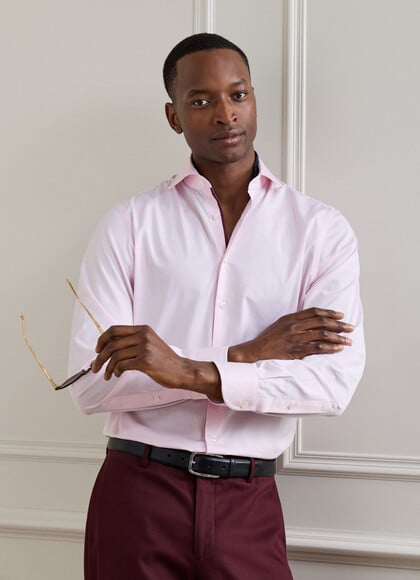
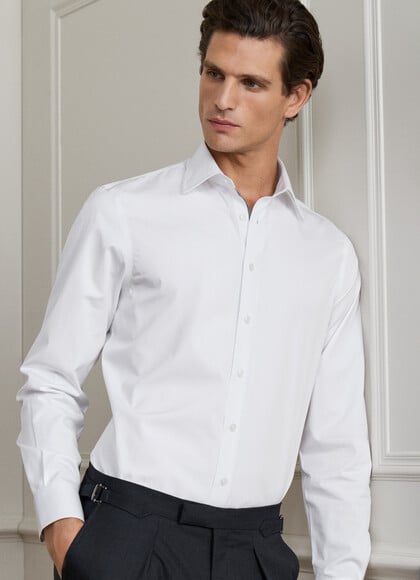


Savile Row shirts
Savile Row shirts from Hackett London are the most direct argument for long-staple pima cotton: fabrics at over 100 threads per square centimetre that distinguish themselves to the touch before you put them on, and that improve with every wash for years.
Cloths and construction
Savile Row shirts work principally with two-ply long-staple pima poplin — the fabric with the highest thread density and the most pronounced natural lustre in the smooth cotton family — and high-density Oxford weave for the more informal models. The two-ply poplin has an almost waxy surface to the touch: the fibre is so fine and so tightly woven that the shirt does not crease with the same pattern as a standard poplin, and the collar holds its shape even at the end of a long day. The high-density Oxford has a more visible texture and absorbs moisture more readily — the option for warm days or for those who prefer a shirt with more body in the hand.
The internal seams of the more carefully made models are in double-felled construction: the cloth folds over itself and is stitched twice, eliminating raw edges and multiplying seam strength through washing. Buttons are in natural mother-of-pearl or vegetable ivory in the premium references — a touch and a finish that plastic does not approach.
Collars and cuffs
Savile Row shirts offer the Italian collar, the classic English spread, the pin collar with bar and the button-down. The Italian collar — medium points with enough spread for a tie — is the most versatile: it works with suit and tie, with suit and no tie, with a casual blazer and with a jumper over the top. The button-down is the least formal and the one that sits best without a blazer. Cuffs are single for cufflinks or double-button in the dress models; the double-button cuff rolled to the forearm is the natural option for registers without a blazer.
How to wear Savile Row shirts
Savile Row shirts are the foundation on which the rest of the wardrobe is built. Two compositions:
White poplin Savile Row shirt, navy suit, burgundy silk tie and black calf Oxford: the combination that does not fail in any context — from a Pall Mall club lunch to a wedding at St Paul's.
Mid-blue Oxford Savile Row shirt, tweed blazer, grey flannel trouser and brown leather Derby without a tie: the everyday look that demonstrates the cloth quality is sufficient without needing to add anything further.
The Savile Row shirts colour that returns most is white and mid-blue: white is universal and brings light to the composition; mid-blue combines with navy, grey, camel and brown without generating conflict. Darker blues, stripes and checks require a more considered composition — but have more character for it.
Care
Savile Row shirts in long-staple pima poplin can be machine washed at 40°C; two-ply poplin models benefit from 30°C to maintain the lustre longer. Always press damp or with steam from inside the collar outward. Mother-of-pearl buttons are fragile to impact: removing the shirt from the drum without pressing it against the metal edges prevents the majority of breakages.
What is the difference between Savile Row poplin and standard poplin?
Savile Row poplin uses two-ply long-staple pima cotton: longer, stronger and more lustrous fibres than the short uncombed cotton of cheap poplin. Thread density is 100 or more per square centimetre, against 60–80 for standard poplin. The result: a smoother surface, a drier touch, a crease that is easier to release and a garment that lasts three to five times longer before the cloth begins to lose its body.
How many Savile Row shirts does a wardrobe need?
Three covers the working week with margin: one white in poplin for the most formal days, one mid-blue in poplin for everyday use, and one in Oxford blue or a quiet check for meeting-free days or the weekend. A fourth in sky blue or fine stripe widens the rotation without adding combinatorial complexity.
How do you size Savile Row shirts?
Savile Row shirts follow European sizing in collar and sleeve centimetres. The collar must admit one finger between cloth and neck without gripping: if the finger enters easily but without play, the size is right. For wearing under a blazer, the Slim Fit cut is the appropriate choice for most builds; for wearing untucked or with more freedom of movement, Regular Fit gives more room through the body without needing to go up a collar size.